The telematics industry is growing fast — and so is the complexity of managing it. Service providers today are expected to deliver reliable GPS tracking, driver behavior monitoring, fuel management, temperature sensing, remote immobilization, and much more. The pressure to meet diverse customer demands has pushed many providers into a dangerous habit: deploying multiple different hardware devices across their fleet management platform.
It sounds like a reasonable solution at first. Different devices for different use cases, right? In reality, it is one of the most expensive and operationally draining strategies a telematics company can adopt.
In this article, we will explain exactly why multi-device sprawl is quietly destroying margins for telematics providers — and then introduce why the Gosafe GTU60 entry-level fleet tracker is the smarter path forward.
The Multi-Device Trap: How Telematics Providers Are Wasting Time and Money
Many telematics service providers (TSPs) operate with a portfolio of 4, 6, or even 10+ different GPS tracking hardware models. Each device was added to the lineup to solve a specific customer problem. But over time, this approach creates a cascade of hidden costs and operational headaches that are rarely discussed openly.
1. Inventory Management Becomes a Nightmare
Every device model you carry requires separate stock. That means separate purchase orders, separate minimum order quantities, separate storage bins, and separate tracking in your ERP or warehouse system. When demand shifts — as it frequently does in telematics — you end up either overstocked on slow-moving units or out of stock on the ones your customers urgently need. The carrying cost of managing a fragmented inventory is substantial, and the risk of obsolescence increases with every additional SKU you hold.
2. Technician Training Costs Multiply
Each device model has its own wiring harness, its own configuration protocol, its own firmware quirks, and its own troubleshooting procedures. Every time you add a new installer or field technician, you are not training them on one device — you are training them on a library of devices. Mistakes during installation are far more likely when technicians must switch between multiple product types on the same day. And every installation error translates directly into customer dissatisfaction and expensive truck rolls.
3. Software Integration Headaches Never End
Even if your tracking platform is compatible with multiple device protocols, managing firmware update schedules, protocol version differences, and feature capability mismatches across a diverse device fleet is a full-time engineering burden. Testing a new platform feature across eight different device models takes eight times as long. Bug reports related to one device often cannot be replicated on another, creating perpetual ambiguity in your support queue.
4. Procurement Leverage Is Completely Diluted
When your purchase volume is spread thin across multiple manufacturers and models, you lose the ability to negotiate meaningfully on price, lead times, or customization. You are not a priority account for any of your suppliers. Contrast this with a provider who concentrates volume on a single trusted platform — they can negotiate better pricing, faster production slots, co-development opportunities, and priority technical support.
5. Customer Support Becomes Chaotic
Your support team is essentially running multiple specialized helpdesks simultaneously. When a customer calls with an issue, the first challenge is identifying which device they have installed. Then the agent must mentally switch to the correct knowledge base, the correct diagnostic steps, the correct firmware version matrix. Response times go up, first-call resolution rates go down, and customer confidence in your platform erodes.
6. Certification and Compliance Costs Are Multiplied
In many markets, telematics devices must carry local regulatory certifications such as FCC, CE, IMDA, or RCM. Maintaining certifications for multiple device models across multiple target markets is a significant and often underestimated ongoing expense. Each new market entry requires revisiting compliance for every device in your portfolio.
The uncomfortable truth: Most telematics providers do not need 8 different devices. They need one versatile, well-supported platform that covers the vast majority of their use cases — deployed consistently, trained thoroughly, and managed efficiently.
The Case for Standardization: One Platform, Most Possibilities
Industry-leading telematics providers who have achieved scale and strong margins share a common discipline: they resist the temptation to add new hardware models to their portfolio unless there is a truly compelling reason. They standardize on a core platform, build deep expertise around it, and extend its capabilities through accessories and configuration rather than by proliferating hardware SKUs.
This standardization strategy delivers compounding returns over time. Technicians become expert-level installers. Support teams develop deep institutional knowledge. Procurement teams earn preferred partner status with manufacturers. Engineering teams ship new platform features faster because they test against fewer device variants.
The question, then, is not whether to standardize — it is which device to standardize on.
Introducing the Gosafe GTU60: One Device, Multiple Possibilities
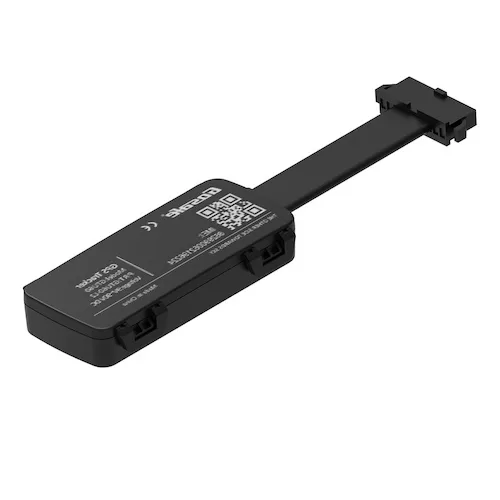
The Gosafe GTU60 was engineered with a clear mission: to serve as a universal entry-level telematics platform capable of meeting the overwhelming majority of fleet management requirements without compromise. It is designed for telematics service providers who want to consolidate their hardware portfolio without sacrificing capability.
Built by Gosafe Company Ltd., a manufacturer with decades of GPS hardware development expertise and a global partner network that includes Navixy, Wialon, GPS-Server, and GPS Gate among others, the GTU60 is not a minimal tracker — it is a remarkably capable device offered at an entry-level price point.
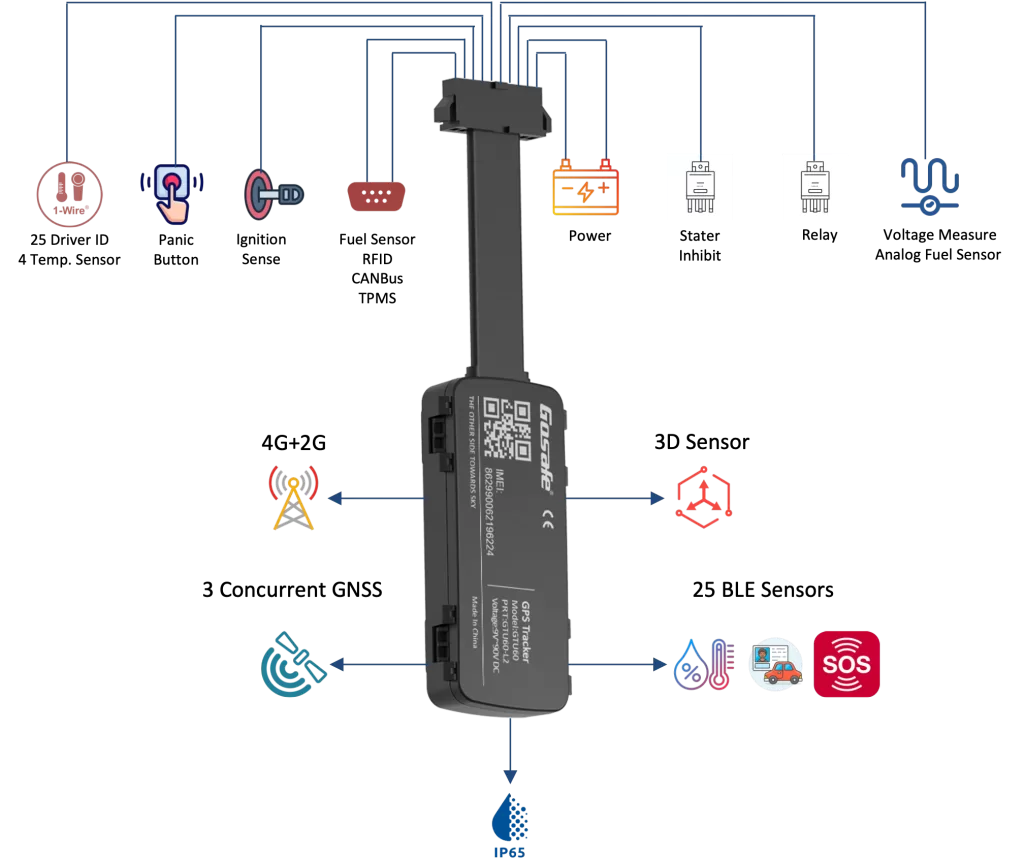
Why the GTU60 Covers 90–95% of Telematics Service Provider Needs
4G LTE CAT1 with 2G Fallback — Future-Ready Connectivity
2G and 3G network shutdowns are accelerating across the Americas, Europe, and Asia-Pacific. Providers still deploying 2G-only devices are running a ticking clock that will force costly fleet-wide hardware replacements. The GTU60 leads with 4G LTE CAT1, supporting ten LTE bands (B1, B2, B3, B4, B5, B7, B8, B20, B28, B66) for broad global coverage, while retaining 2G GSM fallback on 850/900/1800/1900 MHz for areas where LTE coverage remains sparse. This is the connectivity foundation that telematics providers need for the next decade.
Multi-Constellation GNSS — Precise Positioning Everywhere
The GTU60 incorporates a 32-channel GPS engine with simultaneous support for GPS, GLONASS, and BeiDou satellite constellations, achieving SBAS-corrected accuracy of 10.0m CEP and an impressive tracking sensitivity of -162dBm. This means reliable positioning even in challenging urban canyons, dense foliage, and underground parking environments where lesser devices struggle. Assisted GPS (AGPS) support further accelerates cold-start time, ensuring your customers see vehicle positions quickly after ignition.
Flexible I/O Architecture — The Key to Versatility
What distinguishes the GTU60 as a platform rather than just a tracker is its comprehensive input/output architecture. A single unit supports a dedicated ignition sense wire, one digital input, one analog input, two digital outputs (open drain, 300mA max each), a 1-Wire interface, and a UART/RS232 serial port. This means a single GTU60 can be configured for:
-
- Basic GPS tracking and live map visibility
- Ignition monitoring and engine hours reporting
- Driver ID verification via iButton on the 1-Wire bus
- Temperature monitoring for refrigerated transport using 1-Wire temperature sensors
- Fuel level monitoring via analog input connected to fuel sensors
- Remote engine immobilization via digital output relay control
- Driver behavior scoring using the onboard 3D accelerometer (harsh braking, acceleration, cornering)
- Crash data recording at 10Hz sampling rate for insurance telematics applications
- Serial-connected accessories such as driver displays, RFID readers, or external modems
BLE 5.0 — Wireless Sensor Ecosystem
The onboard Bluetooth Low Energy 5.0 module opens the GTU60 to an expanding ecosystem of wireless sensors and peripherals. BLE tire pressure monitoring systems, BLE temperature and humidity sensors, BLE door sensors, and BLE driver ID tags can all be integrated without adding wiring complexity to the vehicle installation. This is a critical capability for rental fleets, shared mobility operators, and cold chain logistics providers.
Wide Voltage Range — One Device for Cars, Vans, and Heavy Trucks
The GTU60 operates across a 9-90V DC input range, making it natively compatible with both 12V light vehicle electrical systems and 24V heavy commercial vehicle systems. There is no need to maintain separate device models for passenger cars and trucks — the same GTU60 unit handles both. Average active tracking power consumption is just 25mA at 12V, with a sleep current of only 4mA, ensuring minimal drain on vehicle batteries during extended parking periods.
Compact, Rugged, and Simple to Install
At just 78 x 33 x 15mm and 35 grams, the GTU60 is among the smallest fleet management trackers available with this feature set. Its IP65-rated water-resistant housing withstands harsh installation environments, and its operating temperature range of -20°C to +75°C (with storage rated to -40°C/+85°C) ensures reliable performance across climates from desert heat to arctic cold. The 10-pin Molex connector provides a secure, standardized wiring interface. Built-in cellular and GPS antennas eliminate the need for external antenna routing in most installations.
Onboard Memory — No Data Loss During Connectivity Gaps
The GTU60 stores up to 3,000 records onboard with its 4Mbit flash memory. When cellular connectivity is interrupted — in tunnels, remote areas, or network outages — the device continues logging position and event data locally, then automatically transmits the buffered records when connectivity is restored. Your customers never see data gaps on their tracking platform.
GTU60 Key Specifications at a Glance
| Connectivity | 4G LTE CAT1 / 2G GSM fallback |
| LTE Bands | B1/B2/B3/B4/B5/B7/B8/B20/B28/B66 |
| GSM Bands | 850/900/1800/1900 MHz |
| GNSS | 32-channel GPS + GLONASS + BeiDou |
| GNSS Accuracy | SBAS 10.0m CEP, -162dBm sensitivity |
| Voltage Range | 9–90V DC (12V & 24V systems) |
| Power Draw | 4mA sleep / 25mA active tracking |
| Bluetooth | BLE 5.0 onboard |
| I/O | 1 DIN, 1 AIN, 2 DOUT, 1-Wire, RS232/UART |
| Accelerometer | 3D onboard, 10Hz crash data |
| Memory | 4Mbit flash (3,000 records) |
| Dimensions | 78 × 33 × 15 mm, 35g |
| IP Rating | IP X5 water resistant |
| Temperature | -20°C to +75°C operating |
| SIM | 4FF Nano SIM (internal) |
| Mounting | Velcro, tie wrap, or adhesive |
Who Should Consider the GTU60 as Their Standard Platform?
The GTU60 is the ideal standardization choice for:
-
- Small and mid-size fleet operators seeking a cost-effective but capable tracking solution
- Telematics service providers building a scalable, supportable device portfolio
- Vehicle rental and leasing companies requiring flexible, easy-to-install units
- Usage-based insurance programs needing crash data and driver behavior scoring
- Transportation and logistics operators managing mixed 12V/24V fleets
- Cold chain providers who need temperature monitoring without a specialized device
- Buy-Here-Pay-Here dealerships requiring remote immobilization capability
Conclusion: Simplify to Scale
The telematics providers who will thrive in the next decade are not the ones with the largest device catalogs — they are the ones who have the operational discipline to standardize, the technical confidence to select the right platform, and the commercial intelligence to concentrate their purchasing power.
The Gosafe GTU60 was built to be that platform for the majority of telematics use cases. With 4G LTE connectivity, multi-constellation GNSS, BLE 5.0, comprehensive I/O including 1-Wire and serial port, onboard accelerometer, and wide voltage compatibility — all in a compact, IP-rated housing — the GTU60 is ready to handle what your customers need today and the features they will ask for tomorrow.
Stop managing a device zoo. Start building a scalable telematics business on a single, versatile platform.